
Generating a product description with AI takes ten seconds. Getting one you can publish without rewriting it is a different matter. Between the two sits a question most tools sidestep: where does the information come from?
This article describes an AI-assisted writing method for WooCommerce that fits in a single rule: write only from verified data. It applies to a catalog of a hundred SKUs as well as ten thousand, whether you sell wine, cosmetics, power tools or spare parts.
Why generated descriptions disappoint
A description generator receives a product name, sometimes a category, and produces text. The language model does what it does best: it writes something plausible. For a 12 V drill, it will mention “powerful” torque, a “long-lasting” battery, a “convenient” chuck. None of these claims is false in the strict sense, and none is true either. They are hollow.
The second problem is more serious. Pushed to be specific, the model puts forward numbers: 35 Nm, 1.2 kg, a 3-year warranty. It pulls them from its training memory, which is to say from a blend of neighboring products. Some are right, others belong to a different model, and that is precisely the error a customer will spot.
The third problem is invisible on the page but weighs on the store: nothing is structured. The description exists, the attributes stay empty, the filters do not work, the Google Shopping feed goes out without data. The product page looks complete, yet the product data still does not exist.
Start with research, not with writing
A competent e-commerce copywriter never starts by writing. They open the manufacturer’s page, the technical PDF, two or three retailer pages, and they note what is established. That is exactly what you should ask the AI to do first.
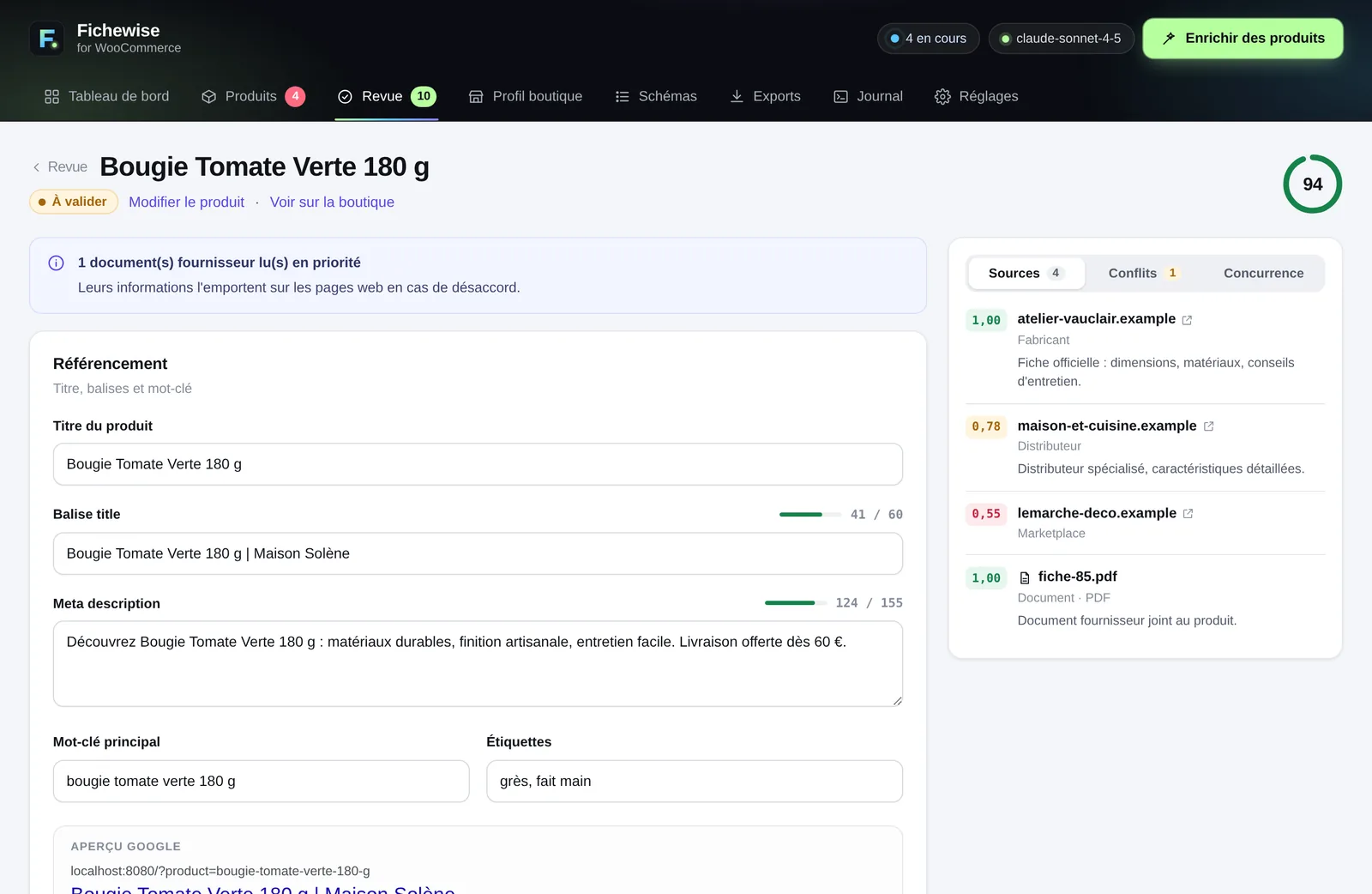
In practice, research starts from the most precise identifier available: the EAN, then the manufacturer part number, then the brand and model. Each query brings back pages. They are not all equal. A page on the brand’s own site is worth more than a marketplace listing, which is worth more than a comparison site, which is worth more than a forum. This ranking is formalized as a reliability score per source, and that score is what settles disagreements later.
You also have to accept discarding pages. A search for “Karvéo PV-1235” will return the PV-1235, but also the PV-1230 and the PV-1235-K kit. A page that describes a different product must be excluded before extraction, otherwise its specs contaminate the product page.
The documents you already have are worth more than the web
For part of any catalog, the web knows nothing: a single-estate vintage, a cream formulated for a retail chain, an unbranded part. The seller, on the other hand, almost always has something: a PDF spec sheet sent by the supplier, a range catalog, a photo of the label.
These documents should be the first source, with the highest reliability. Current models read a PDF or an image directly: a spec table in a data sheet, a vintage and an ABV on a label, an INCI list on packaging. When a seller document and a web page disagree, the document wins.
One attribute schema per category
Extracting attributes without a framework produces clutter: “Weight,” “net weight,” “Poids,” “Mass” for the same piece of information. The solution is a canonical schema per category, defined once. For wine: appellation, grape varieties, vintage, ABV, volume, cellaring window, food pairings. For power tools: voltage, torque, weight, chuck, batteries included, warranty.
Extraction then runs against that schema, source by source. Every value found keeps three things: its source, the quote that supports it, and a confidence level reflecting how clear the mention was (an official table scores 1, an ambiguous sentence scores 0.3).
Merge, and flag conflicts instead of hiding them
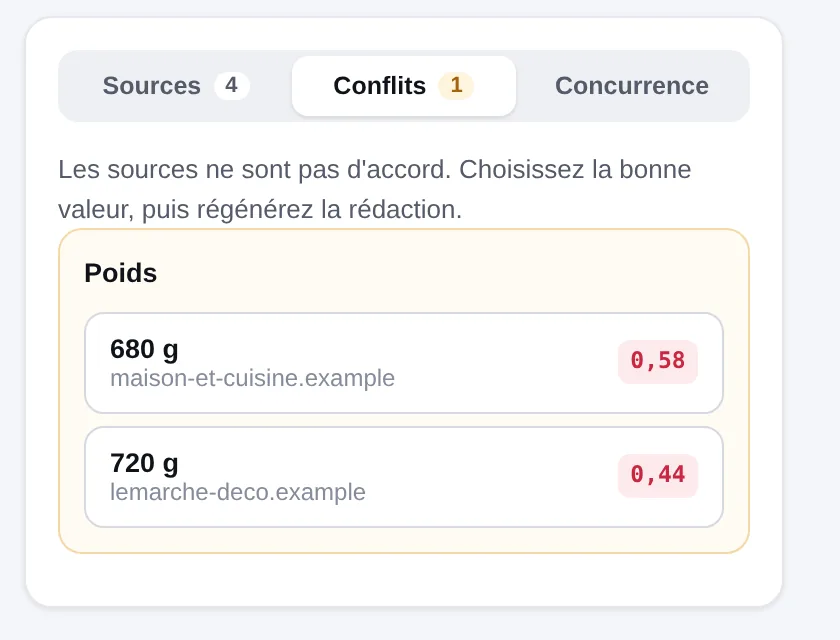
When three sources give the weight, you have three entries. Merging means grouping them by attribute and normalized value, then letting the sources vote, each weighted by its confidence multiplied by its reliability. The winning value becomes the retained attribute, along with the list of its sources.
What matters is what happens when the vote is close. An honest tool does not decide: it marks the attribute as conflicting, presents the options with their sources, and lets the merchant choose. An attribute backed by a single weak source is not retained either. It is displayed as “unconfirmed” and does not appear in the text. The result is a smaller set of attributes than a generator would have produced, but every one of them can be traced back to a page or a document, which is the only kind of data you want feeding your filters and your feed.
Write against the competition, not in a vacuum
Once the attributes are established, you can write. But write what, and how long? The answer lies in the pages already ranking for the purchase query. Reading the first six or eight results gives you a median length, a typical outline, the list of attributes everyone displays, whether or not there is a FAQ, and the questions shoppers actually ask.
This brief guides the writing: aim slightly longer than the median, cover the expected sections, answer the real questions, bring what competitors lack. That last point is the one that counts for Google as much as for AI assistants: a page that provides information found nowhere else has a reason to be cited.
Review automatically before reviewing by hand
The last step before a human is a second AI pass with a different role: reviewer. It receives the text and the verified attributes, and it checks that every number, every material, every mention of origin or certification has a counterpart in the attributes. It also checks style (no empty superlatives, no casual tone) and lengths (title tag, meta description).
This pass catches what the writer lets through: a “3-year warranty” lifted from a single source, a volume inferred from a neighboring product. It corrects, it scores, and it produces a list of remarks for the human reviewer. That human review is then a matter of minutes per product rather than a full rewrite, because the reviewer is checking flagged points against listed sources instead of re-researching the product from scratch.
What this changes in WooCommerce
The result is not a description, it is a complete product page: title, short description, long description with a spec table, key benefits, FAQ, title tag, meta description, focus keyword, tags, image alt text, global attributes, GTIN. The attributes feed the filters and the Shopping feed, the FAQ produces structured data, the SEO fields populate Rank Math or Yoast.
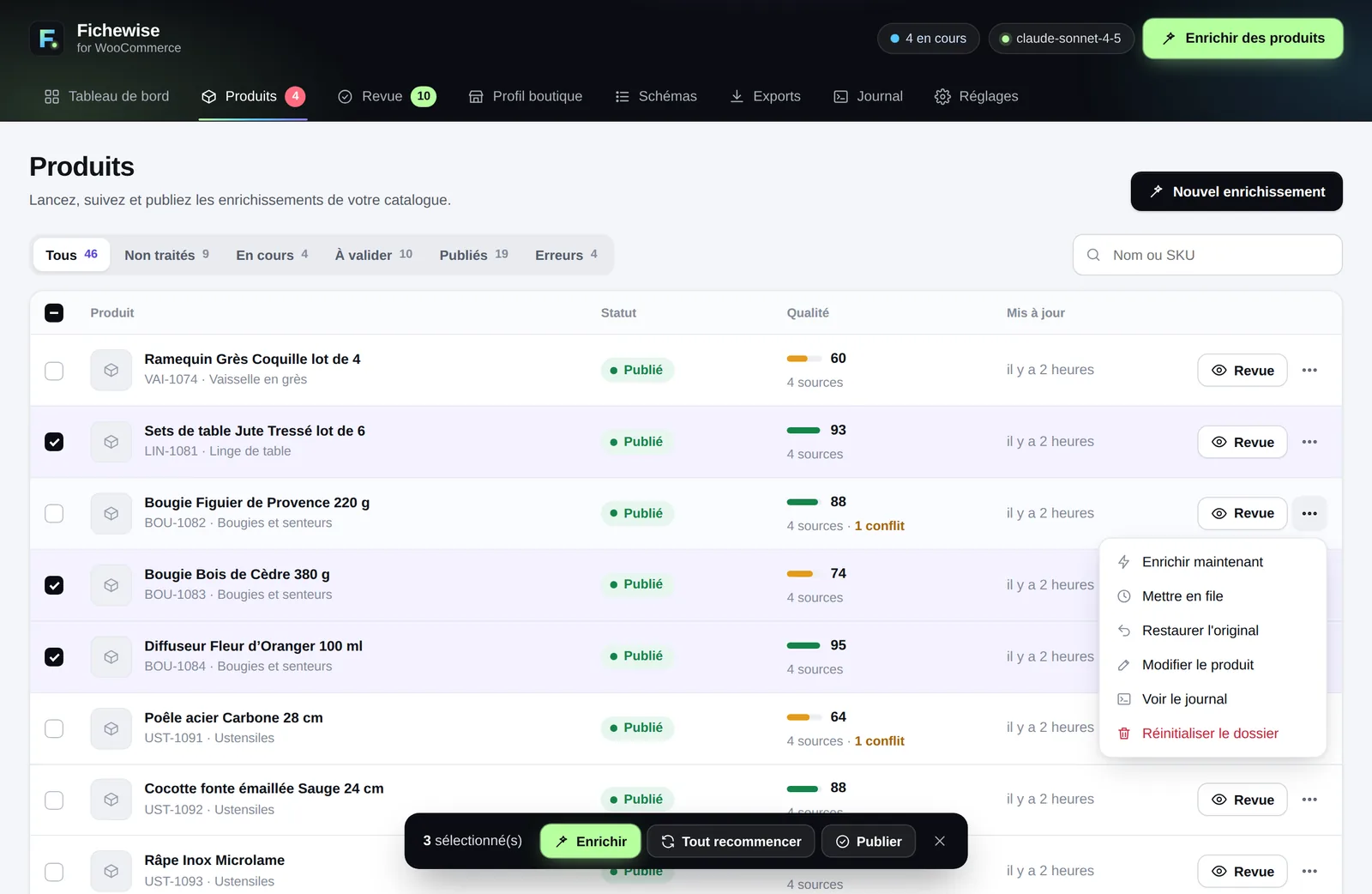
And the previous content is backed up. A catalog gets corrected in batches, so you need to be able to roll back.
In practice
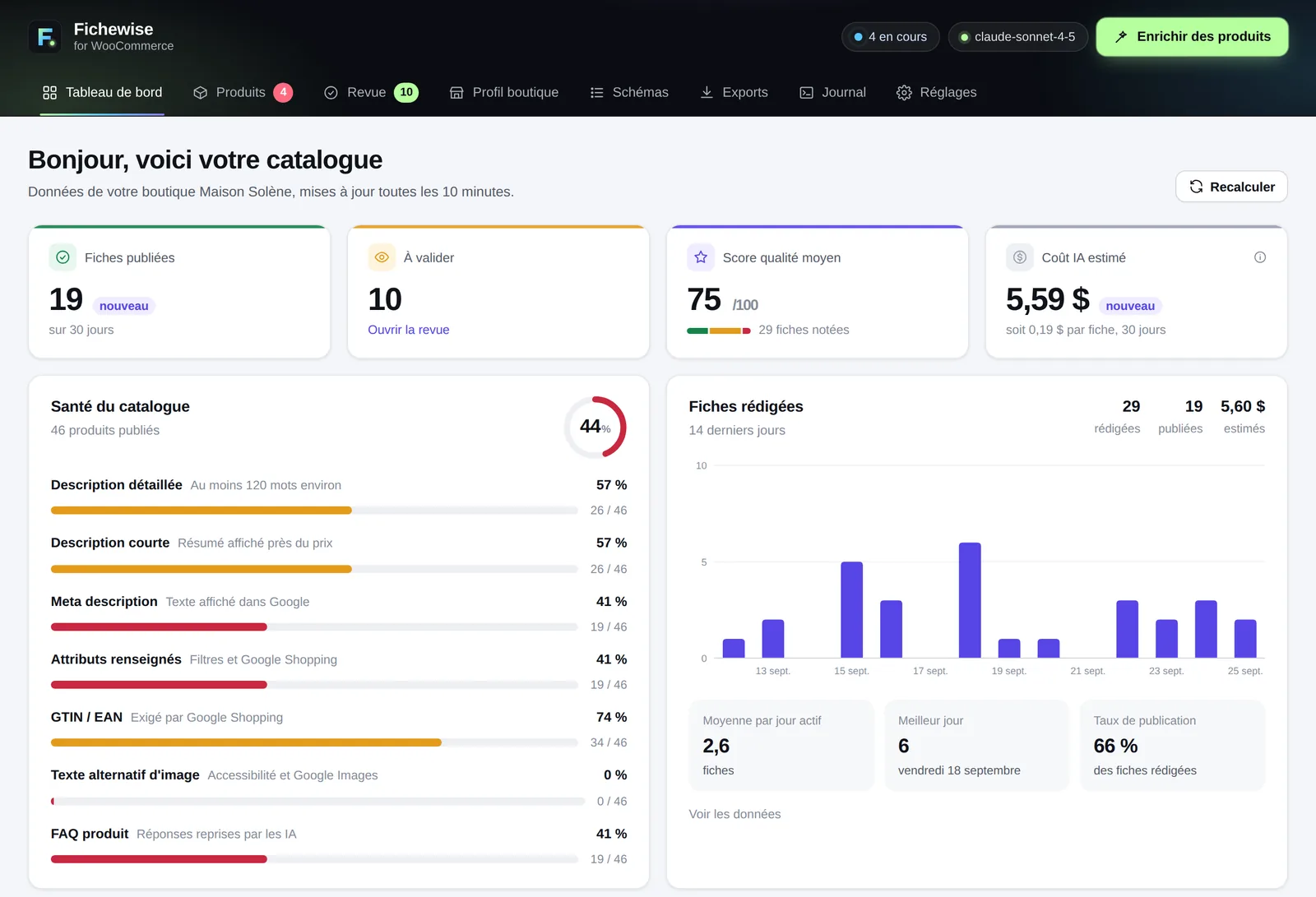
This method is the one we built into Fichewise, a licensed WooCommerce plugin. It runs either on your own API keys (the cost is then limited to that of the API, around €0.25 per product page) or through the managed service with credit packs, with no key to manage; the pricing page details both options. On your first product pages, look at the sources panel, and judge for yourself. The Features page walks through every step.